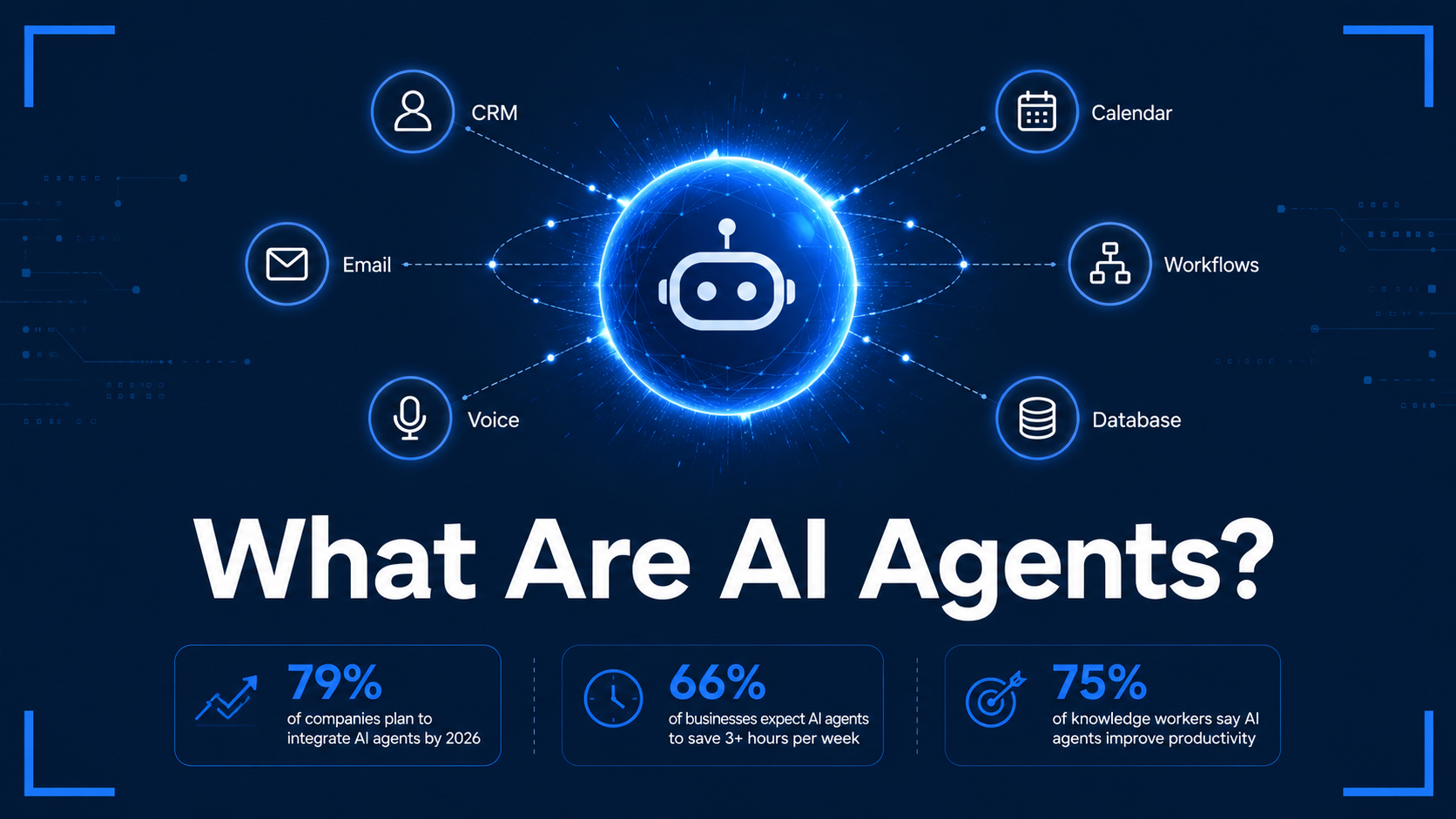
If you run a small business and still have team members handling follow-up emails, scheduling calls, entering data into spreadsheets, or answering the same customer questions over and over — you are paying human wages for work that should not cost human hours. That is not an opinion. The numbers make it impossible to argue otherwise.
A survey conducted by Slack across 2,000 U.S. small business owners found that the average entrepreneur loses 96 minutes of productive time every single day to tasks that are repetitive, low-value, or entirely avoidable. Across a full work year, that adds up to more than three full work weeks gone. And research from IDC puts the financial damage at roughly $1.7 million in wasted productivity per 100 employees. For a business with even 10 people on the payroll, the cost is still staggering.
This is the problem that AI automation was built to solve. And in 2025, it is no longer a future-facing concept — it is already running inside businesses that look a lot like yours.
The Tasks Getting Replaced First
Not all automation is created equal. The clearest wins come from tasks that are repetitive, rule-based, and time-consuming — the kind of work that keeps your team busy but does not actually move the business forward.
According to data from a 2026 survey on SMB automation adoption, the six tasks small businesses are automating most aggressively right now are:
- Lead follow-up and outreach sequences — automated within seconds of a form submission or missed call
- Appointment booking and calendar management — with 55% of automating SMBs already handling this without human involvement
- Market research and data gathering — AI pulling and summarising competitive intel that used to take hours
- Data entry and CRM updates — information flowing automatically between systems with no manual input
- Invoice chasing and payment reminders — triggered on schedule without anyone remembering to send them
- Inbound customer calls and first-touch support — handled by AI voice agents that qualify, answer, and book
Each one of these tasks has a real hourly cost attached to it. When you pay a member of your team to do them manually, you are spending somewhere between $25 and $60 per hour on work that a well-configured automation system handles in milliseconds — and does not need a lunch break.
What AI Voice Agents Are Doing to Phone-Based Businesses
The area where the shift is most visible — and most impactful — is inbound communication. For service businesses in particular, missed calls mean missed revenue. A lead who calls and reaches voicemail does not wait around. They call your competitor.
AI voice agents change that equation entirely. These are not robotic phone trees with clunky menus. Modern AI voice systems, built on platforms like Vapi and Retell AI, carry on natural conversations, ask qualifying questions, handle objections, and book appointments directly into your calendar — at any time of day, without any human on the line.
For a small business owner who has ever lost a client because no one picked up the phone at 7pm on a Tuesday, this matters enormously. The technology is not experimental anymore. It is production-ready, and it is being deployed right now by businesses with five employees and businesses with 500.
The Workflow Automation Layer Most Businesses Are Missing
Beyond voice, there is a second category of automation that quietly handles the operational backbone of a business — and most small business owners have no idea how much of it can be removed from their team's workload entirely.
Client onboarding is a strong example. When a new client signs on, the average business manually creates folders, sends welcome emails, sets up project management tasks, triggers invoices, and notifies the relevant team members. Each step takes a few minutes. Across 30 new clients a month, it starts to consume days.
A properly built workflow automation handles the entire sequence the moment a contract is signed. No one has to remember. No step gets missed. And your team's attention stays on the work that actually requires human thinking.
The same principle applies to invoice chasing, internal reporting, follow-up sequences, and system integrations between tools like your CRM, calendar, and billing platform. Most small businesses are running these systems in parallel with no connection between them — which means someone is manually bridging the gap every single day.
Why Small Business Owners Are Acting Now
There is a practical reason the adoption curve is accelerating. According to the same SMB survey, 10% of small businesses are investing in automation to offset rising operating costs — compared to only 3% who are choosing to reduce headcount. Automation has become the preferred answer to a margin problem that is not going away.
And the businesses that move first are building a structural advantage that compounds over time. When your team is no longer spending hours on manual data entry or follow-ups, they are spending that time on client relationships, new service development, and growth activity. The output difference between an automated business and a manual one widens every month.
PrompTive clients report getting back an average of 20 hours a week in month one of implementation. Across the portfolio, that figure adds up to more than 40,000 hours saved every month. Those are not inflated projections — they are the result of mapping real processes and replacing the manual parts systematically.
Where to Start
The most common mistake businesses make with automation is trying to do everything at once. The smarter approach is to identify the one task that costs your team the most time per week and build your first automation around that. Measure the hours saved. Then move to the next one.
If you are not sure where your biggest time cost actually sits, that is a process audit question — and it is exactly the conversation we have with every new client before building anything. There is no point automating the wrong thing first.
The goal is not to replace your team. It is to make sure your team's time goes toward work that only they can do — and that the rest runs on its own.
Book a Free Strategy Call with PrompTive — Find Out Where Your Hours Are Hiding